

【Southeast University News Network, July 10】(Correspondent: Wang Jun) On July 10, Science, the internationally renowned journal, published a paper titled “Proton transport enabled by a field-induced metallic state in a semiconductor heterostructure”. Prof. Zhu Bin, the chief scientist of SEU Solar Energy Technology Research Center/Energy Storage Joint Research Center, is the co-author and the main corresponding author of this paper. This research achievement marks the significant progress made by SEU in the field of fuel cell research.
For the fuel cell, as a key area of the national energy development strategy, the electrolyte is its core component and the performance of the electrolyte’s ionic conductivity determines the performance of the fuel cell. At present, the development and application of fuel cell performance is restricted by the electrolyte featuring a lower ionic conductivity.
The solid oxide fuel cell (SOFC) electrolyte, despite the centennial development, still has no substitute for its yttrium-stabilized zirconium dioxide (YSZ) for oxygen ion conduction. Its oxygen ion conductivity can only reach the high-performance SOFC conductivity of 0.1 S/cm at about 1000°C. In order to solve this challenge, Goodenough, the Nobel Prize winner, published a paper in Nature in 2000 proposing the design of oxygen ion conductors by the traditional structured ion doping method, that is, to replace the high-valent cations with low-valent cations, such as doping Y3+ with the structure Zr4+ to form an oxygen vacancy, which in turn produces the oxygen ion conductivity. However, the structural doping still failed to solve the challenge proposed by SOFC electrolyte and has hindered the commercialization of fuel cells.
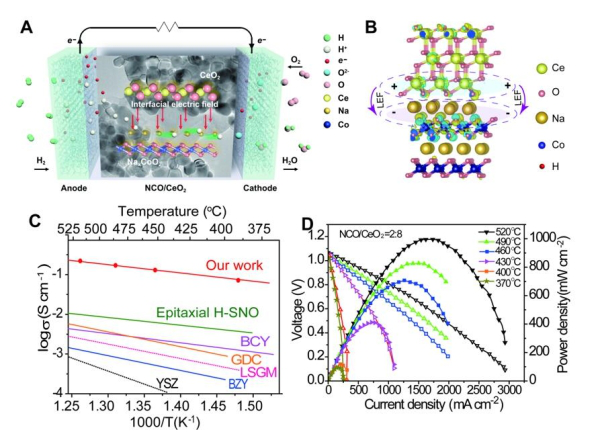
Prof. Zhu Bin et al. adopted a method completely different from the traditional structural doping of ion conductors by constructing a heterostructure of semiconductor materials, then localized the protons at the heterointerface by utilizing the electronic/metallic characteristics of the semiconductor heterointerface, designed and constructed a super-proton high-speed channel featuring the lowest potential barrier for migration. In fuel cells, the protons are electrochemically embedded onto the interface of heterogeneous materials, and then repelled to the surface of sodium cobalt by the surface of positively charged cerium oxide; but at the same time they are extruded by positively charged sodium ions and thus cannot enter the interior of sodium cobalt, therefore, these protons are localized in the interface space of the two materials and achieve continuous and rapid migration between the layers with the lowest potential barrier. The experiment has successfully verified the theory and calculation results, which obtained extremely excellent proton conductivity (several orders of magnitude higher than the conductivity of the traditional YSZ-based electrolyte material have been achieved) and demonstrated the advanced proton ceramic fuel cells (see the figure below).
The semiconductor heterostructure and the field-induced accelerated ion migration constitute a brand-new scientific mechanism. On the basis of a large amount of research, a new discipline and methodology are being formed: the semiconductor ionology --- the emerging frontier discipline that studies the ion transport rules and applications of semiconductor materials (the research proposed and led by Prof. Zhu Bin). Comprehensive and in-depth research in this regard will inevitably bring about breakthroughs in terms of new materials and technologies in the energy field, which is of universal guiding significance.
This studyhas provided a very effective strategy for the scientific design of excellent proton transmission materials, and provided a scientific method for proton-limited transmission and controllability/adjustability, which has thus greatly accelerated the commercialization process. This achievement will promote the research and development of a new generation of fuel cells, and have important scientific significance and application value for the development of new energy technologies. The research was supported by the National Natural Science Foundation of China and Southeast University High-level Talent Introduction Program.
The paper’s link:
https://science.sciencemag.org/content/369/6500/184?utm_campaign=toc_sci-mag_2020-07-09&et_rid=99219654&et_cid=3401489
Submitted by: SEU Solar Energy Technology Research Center
(Edited by: Li Xiaonan)