

[Southeast University News Network, May 11] (Correspondent: Xiong Ren’gen) In the earlier period, researchers from the International Institute of Molecular Ferroelectricity Science and Application & the Key Laboratory of “Molecular Ferroelectric Science and Application” of Jiangsu Province, the School of Chemistry and Chemical Engineering, Southeast University discovered for the first time the “vortex-antivortex” domain structure in the molecular ferroelectric thin film of a hybrid lead iodine perovskite. A good news from Professor You Yumeng’s team again in the field of molecular ferroelectric materials, they discovered a 2D organic-inorganic hybrid lead iodine perovskite ferroelectric driven by the confinement effect. Related research results were published in the Journal of the American Chemical Society, the top journal in the field of chemistry, with the title of “Confinement-Driven Ferroelectricity in a Two-Dimensional Hybrid Lead Iodide Perovskite”.

Fig.1: Schematic diagram of designing an organic-inorganic hybrid lead-iodine perovskite ferroelectric by using confinement effect
In MOF materials, the guest molecules in the pores are often subject to structural/configuration changes because of environmental constraints from the rigid framework of MOF, thus resulting in some physical or chemical responses that cannot be gained in traditional solid or solution. Similarly, the team introduced such structural confinement effect for the first time into the field of organic-inorganic hybrid perovskites to design a molecular perovskite ferroelectric with superior performance. As shown in Fig. 1, the pure inorganic lead iodide is a two-dimensional layered material with a hexagonal close-packed structure without any ferroelectric property. We assembled an organic nitrogen heterocyclic amine iodide salt that is also a non-ferroelectric with the lead iodide, while in combination with the “fluoro effect” modification strategy, finally successfully synthesized a two-dimensional organic-inorganic hybrid lead-iodine perovskite molecular ferroelectric [4,4-difluorohexahydroazepine] 2PbI4 ([4,4-DFHHA] 2PbI4).
In comparison with the intermolecular forces in the one-dimensional and two-dimensional hybrid perovskites, a two-dimensional organic cation layer was formed under C-F ... H-C weak interactions between the two-fluorine-substituted organic amine cations. Such flexible organic layer is conducive to construct and stabilize the two-dimensional (PbI4) n2-inorganic layer framework. More importantly, in comparison with the one-dimensional packing space composed of PbI6 octahedrons shared by surfaces, this two-dimensional perovskite inorganic layer (PbI4)n2 composed of PbI6 octahedrons shared by vertices features more restrictive forces on the amine cations, as a result, the 4,4-DFHHA cations are frozen in an ordered state at room temperature.
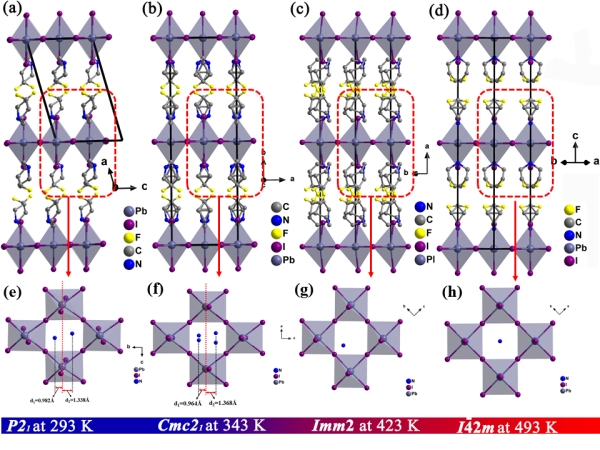
Fig. 2. Comparison of (a-d) [4,4-DFHHA] 2PbI4 crystal packing diagram at different temperatures; (e-h) Simplified distribution diagram of 4,4-DFHHA cations in (PbI4) n2-inorganic layer
As shown in Fig. 2, at 293 K, the 4,4-DFHHA cations, as affected by the confined environment of the two-dimensional (PbI4) n2-inorganic layer, are distributed asymmetrically during the crystal stacking, resulting in spontaneous polarization along the b-axis. When the temperature rises, the thermal expansion of the lattices and the normalization of the twisted PbI6 octahedrons weaken the binding effect of (PbI4) n2-inorganic layer framework on the cations; as a result, the cations are gradually changing from the ordered ferroelectric phase at room temperature to the highly-disordered paraelectric phase at high temperature accompanied by strong reorientation movements, eventually making the polarization zero.
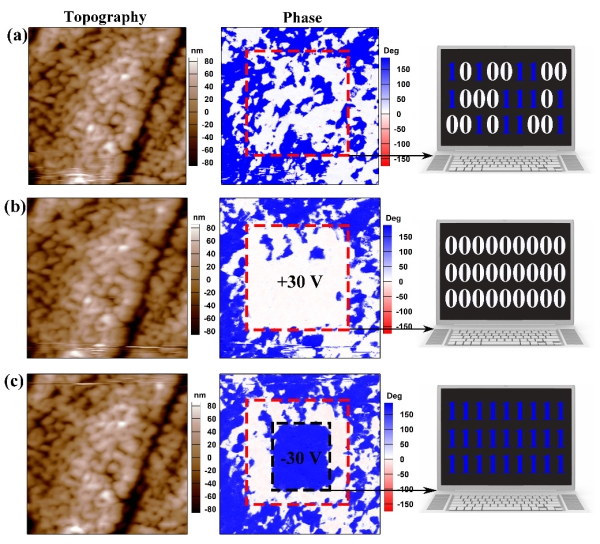
Fig. 3: Thedomain structure and the polarization upset diagram of [4,4-DFHHA] 2PbI4
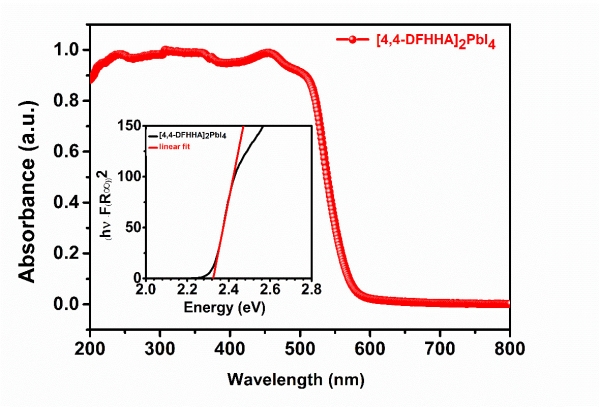
Fig. 4: The ultraviolet-visible absorption spectrometry of [4,4-DFHHA] 2PbI4
Subsequently, we directly observed the ferroelectric domain structure of [4,4-DFHHA] 2PbI4 thin film and its upset in an applied electric field through a piezoresponse force microscopy (PFM), which has directly proved the ferroelectricity of such material (Fig. 3). UV-visible absorption spectroscopy tests indicate that [4,4-DFHHA] 2PbI4 is a direct gap semiconductor with a gap of 2.32eV (Fig. 4). The obvious ferroelectric properties and low-gap semiconductor characteristics at room temperature make it a promising new generation of organic-inorganic hybrid perovskite solar cells based on the ferroelectric photovoltaic effect.
It is reported that this work was accomplished by Chen Xiaogang, Song Xianjiang, Zhang Zhixu et al., Southeast University is the only completion institute, and Professor You Yumeng is the corresponding author. This achievement was supported by the “Cultivation Fund for Top Ten Science and Technology Issues of Southeast University”.
Paper’s link: https://pubs.acs.org/doi/pdf/10.1021/jacs.0c03710
Submitted by: the School of Chemistry and Chemical Engineering
(Editor-in-charge: Tang Tang, reviewed by: Li Xiaonan)